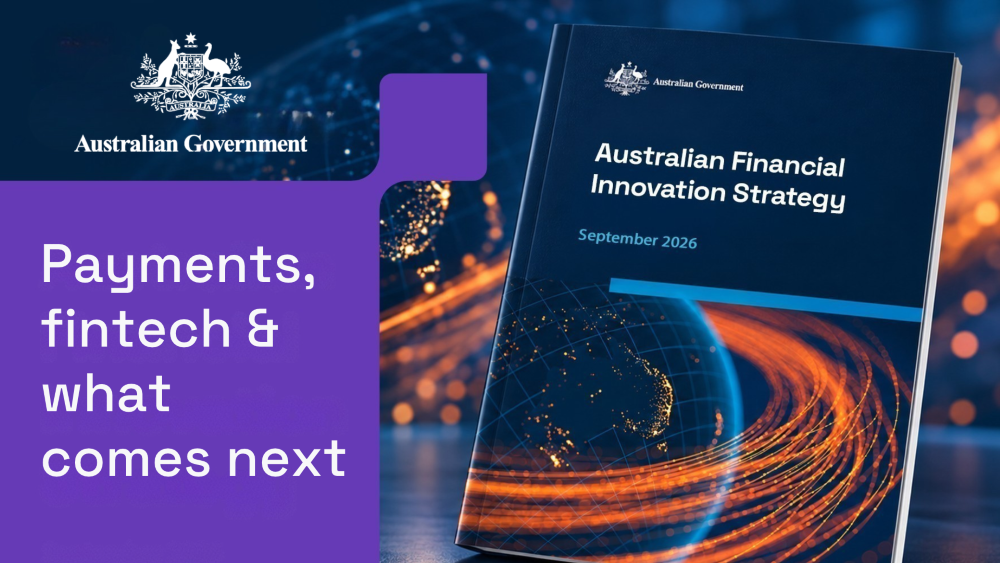
The Australian Government released its Financial Innovation Strategy in September 2026, outlining how technology, data, digital infrastructure and financial innovation will shape Australia's financial system in the years ahead.
The strategy provides an indication of where financial innovation, fintech regulation and payments modernisation are headed. Here’s a look at some key elements and how they may impact Australia’s payments environment.
A vision for the future of fintech
Australia’s central vision when it comes to financial innovation is for an “innovative, resilient and trusted financial system that can harness rapid technological change to support productivity and economic growth”.1
The Government’s role is as steward, setting strategic direction and maintaining principles-based, technology-neutral regulation. Industry, meanwhile, is expected to lead on commercialisation, product development and scaling successful innovation.
Risk management is a key element of the strategy. As cybercriminals and so-called ‘bad actors’ use increasingly sophisticated technology to target consumers and institutions, the financial sector will need the tools to detect fraud, strengthen digital security and respond to threats more effectively.
Australian fintech strategy: Principles and priorities
According to the Financial Innovation Strategy, three connected principles underpin Australia's approach to financial innovation:
- Government leadership, to set direction
- Proportionate and fit-for-purpose regulation
- Collaboration between the public and private sectors
The strategy also identifies several priorities, including:
- New Financial Innovation Committee
- A modernised regulatory sandbox framework
- Targeted thematic sandboxes for areas like AI-enabled financial services and digital financial market infrastructure.
Several reforms are already underway or planned, including improvements to the Consumer Data Right, a new licensing framework for digital asset platforms that the Government has indicated will commence in April 2027 (subject to the passage of legislation), an expanded regulatory perimeter for payments, and a forthcoming update to the Strategic Plan for Australia's Payments System.
A consistent theme brings everything together:
As digitisation increases, so does the importance of cyber security, operational resilience, digital identity and scam prevention in maintaining trust across the system.
What does a Financial Innovation Strategy mean for payments in Australia?
While the Financial Innovation Strategy applies across the broader financial services sector, many of its priorities are directly relevant to payments. Real-time payments, interoperability, digital identity, cyber resilience and programmable services all point to the growing importance of modern payment infrastructure capable of supporting more complex transaction flows.
The strategy has been welcomed by industry groups including FinTech Australia, with CEO Rehan D’Almeida highlighting implementation as the next important step and calling for proportionate regulation that enables businesses to innovate and scale.

For payment providers, the direction is one of continued payments modernisation. The forthcoming Strategic Plan for Australia's Payments System is expected to provide further direction for the sector, building on existing payments regulation and broader financial services reforms.
The strategy also recognises the growing role of AI and automated transactions. For businesses using real-time payment infrastructure such as the NPP, these developments reinforce the importance of scalable and interoperable payment capabilities, alongside digital identity, cyber resilience and scam prevention.
Payment modernisation remains a priority
The Financial Innovation Strategy reinforces that payments modernisation remains a key focus for Australia’s financial system.
Alongside reforms such as the expanded payments regulatory perimeter and digital asset licensing framework, the forthcoming update to the Strategic Plan for Australia's Payments System will provide more specific direction for the next phase of payments modernisation.
For payment providers and businesses, this generally points to continued investment in:
- Real-time payments
- Interoperable payment infrastructure
- Programmable payment capabilities
- Payment automation
- Digital identity and verification
- Operational resilience and cyber security
As payment volumes increase and new technologies emerge, the Strategy suggests that the ability to support real-time and automated payments may become increasingly important.
Monoova's role in Australian financial innovation
Many of the priorities identified in Australia's Financial Innovation Strategy, including payments modernisation, real-time payments, payment automation, cyber resilience and interoperability, align closely with the challenges some businesses already face when moving money at scale. These themes are already shaping how businesses think about payment automation, real-time payments, operational resilience and digital transformation.
As a B2B payments infrastructure provider, Monoova provides businesses with access to real-time payments, PayTo, BPAY, card payments and virtual accounts generally through a single API, supporting payment automation, reconciliation and payments modernisation.
Our team stays connected to the broader payments and digital security ecosystem, collaborating with fraud and cybersecurity practitioners to share practical information and discuss emerging threats. When it comes to security, our platform has been designed with security at the core, and we maintain controls intended to protect client and end user data.
The Financial Innovation Strategy makes clear that progress depends on closer coordination between government, regulators and industry. Monoova welcomes that approach and will keep working alongside industry designed to be fast, secure and adaptable as the payments environment evolves.
Want to know more about how Monoova is driving financial innovation in Australia? Speak with a member of our team today.
1. https://treasury.gov.au/sites/default/files/2026-09/p2026-799948.pdf
FAQs
Q1: What is Australia's Financial Innovation Strategy 2026?
A1: Australia's Financial Innovation Strategy, released in September 2026, outlines the Australian Government's approach to supporting fintech innovation, modernising financial infrastructure, enabling responsible technology adoption and strengthening financial system resilience.
Q2: How will the Financial Innovation Strategy impact payments in Australia?
A2: The strategy supports payments modernisation through real-time payments, interoperable infrastructure, digital innovation and updated regulatory frameworks. It also reinforces the importance of secure and resilient payment systems.
Q3: What does the Financial Innovation Strategy mean for Australian fintech companies?
A3: The strategy outlines initiatives to support fintech development, including regulatory reform, innovation sandboxes and greater collaboration between government, regulators and industry.
Q4: What role will AI play in Australia's financial services industry?
A4: AI could help financial institutions automate processes, detect fraud, improve decision-making and manage transactions. The strategy also emphasises responsible adoption, governance and appropriate safeguards.
Q5: How can Australian businesses prepare for payments modernisation?
A5: Businesses can assess their existing payment infrastructure and explore real-time payments, payment APIs, automated reconciliation and stronger security controls to support future growth and operational efficiency.