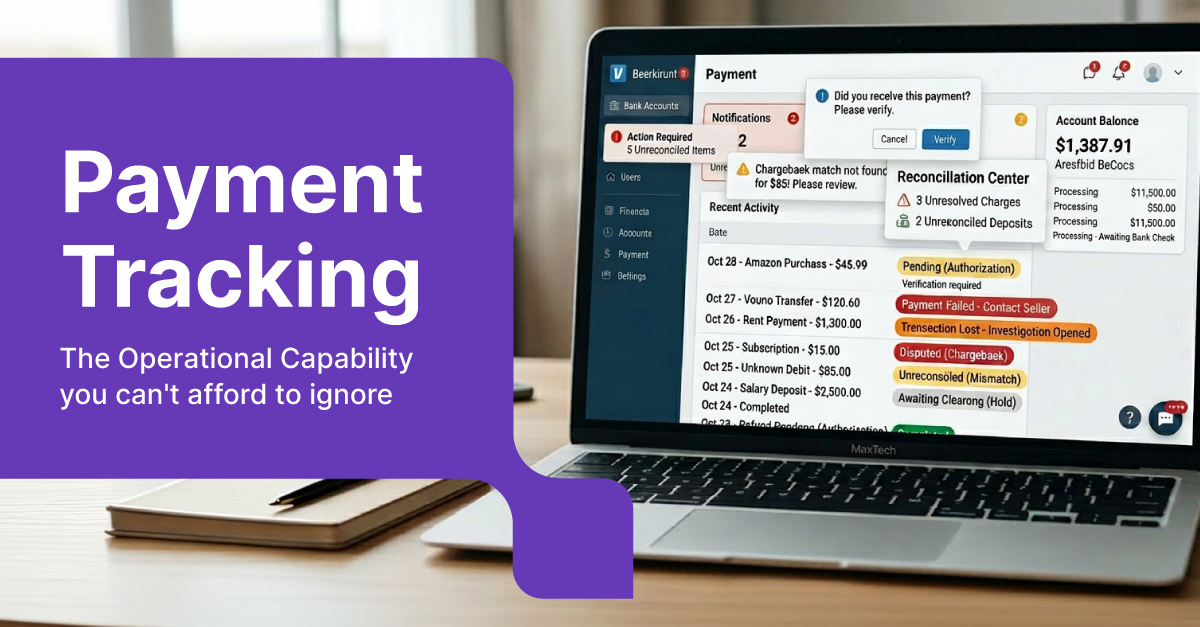

For most organisations, whether they are vendors or service providers, the moment a payment is transferred can feel like the hard part is done. The invoice is sent, the exchange is authorised or the customer has hit the ‘check out’ button. But for finance and product teams managing payments at scale, this is where the complexity can start.
Your finance team may find themselves asking: Where did the money go? Has it settled? Why is this transaction showing a different status in two different systems? Why is reconciliation still not balancing after two days?
This is the reality of operating in a fragmented, multi-channel payment environment, and the cost of poor visibility can be higher than most organisations account for.
The latest payment-tracking technology shows the real-time status of transactions across every payment rail, from initiation through to settlement. It streamlines workflows, reduces bottlenecks and empowers teams to take action quickly when a payment is incorrect.
Monoova embeds this capability directly into its payment infrastructure, combining real-time visibility with automated reconciliation and attribution without requiring businesses to build it in-house.
Why tracking is as important as transactions
Payments that can’t easily be tracked and reconciled can cost time and money while holding back growth.
If transactions aren’t data-rich and easy to reconcile:
- Cash flow forecasting becomes guesswork when finance teams can't confirm whether payments have settled or are still in transit.
- A business running on batch-based reporting may generally be working from a version of the truth that's already out of date.
- Decisions about liquidity, transfers and payroll might be made against yesterday's picture.
As a result, the finance team can lose hours attempting to match transactions, chase lodgement references and cross-reference reports. Every minute spent can add to the cost of doing business.
The problem can also affect customer service teams. When a user contacts support to check whether their payment has been received, finding the answer should take seconds. Instead, agents may find themselves navigating between portals, chasing confirmation from finance, and stalling while the customer waits. In high-volume environments like online marketplaces, educational institutions, and subscription-based businesses (to name a few), this can cause problems with dispute resolution, refund timelines and trust.
The payments expectation shift
The widespread adoption of the New Payments Platform (NPP) in Australia has changed what businesses and their customers expect from payment infrastructure.
NPP-enabled payments settle in seconds, around the clock, every day of the year. PayTo has extended this further by introducing real-time, pre-authorised payment agreements that give both payer and payee greater control and confirmation.
When the underlying payment rail completes complex transfers in an instant, the expectation of confirmation can become equally fast. A customer who pays via NPP and doesn't receive immediate acknowledgement may assume something went wrong. Real-time settlement can raise expectations but without matching visibility and reconciliation, operations may still lag behind the payment itself.
This shift in expectations elevates payment tracking to a front-line operational priority and highlights that the payment experience ends only when both parties have confirmed a settled transaction.

Orphan payments: A small problem that scales badly
One of the most common and costly payment tracking failures is the orphan payment. A customer pays the wrong amount (slightly over or under what’s on the invoice) or transfers funds without a reference, and the payment arrives with no clear owner or reference point.
This ‘orphan’ can't be automatically matched and then sits in a queue waiting for someone to manually investigate.
At low volumes, this is an inconvenience. At scale, these payments can create a growing backlog of unreconciled transactions that tie up cash, increase finance team workload, and leave customers in limbo while the query is resolved.
Monoova addresses this at the source, with virtual account numbers that significantly reduce reliance on payment references by attributing every inbound payment to a specific payer before it even lands, and reconciliation rules that can automatically reject or refund payments that don't match expected amounts in real time.
The result is payments that would previously have stalled in a reconciliation queue are either correctly matched on arrival or more easily handled by an administrator with more data to identify the source of the transfer.
Tracking payments the easy way
Monoova’s unique API helps Australian businesses close the payment-tracking gap by giving finance teams a continuous, accurate view of payment activity from the moment funds move.
At the centre of this is Automatcher, an automated reconciliation feature that assigns each payer a unique virtual account number and, optionally, a PayID. Implement this feature and funds land directly into your business account, already attributed to the right customer, invoice, or business unit. Businesses can also segment payment flows by brand, revenue stream or business unit without maintaining multiple bank accounts, with each ‘virtual account’ providing a clean, isolated view of incoming funds.
Reconciliation rules add another layer of control. Businesses that use Monoova’s payment solution can automatically reject or refund overpayments and underpayments in real time, while whitelisting restricts incoming payments to approved source accounts and rejects anything outside that list immediately.
To provide better visibility, Monoova also ensures detailed source account information, including BSB, account number, and account name, is returned on every inbound transaction.
For businesses that want to move fast, Monoova operates as a plug-and-play solution. A single API integration connects real-time payment rails, automated reconciliation, and settlement visibility into one operational layer. This reduces the need to build matching logic from scratch, manage multiple banking relationships or stitch together reporting from different systems. The infrastructure is ready to connect, and it is designed to scale as transaction volumes grow.
The result is a payment operation that doesn't wait for end-of-day reports and gives finance and product teams a unified view across payment types and settlement cycles, while reconciliation runs automatically in the background.
Across NPP, Direct Entry, BPAY and beyond, Monoova unifies payment tracking, reconciliation and settlement into one operational view, so money won’t move without your team knowing about it, and updates happen in real time.
Gain complete visibility across your payment operations. Track transactions in real time, automate reconciliation and eliminate orphan payments with Monoova's payment infrastructure. Talk to our team today
FAQ
Q1: What is payment tracking?
A1: Payment tracking provides real-time visibility into transaction status from initiation through settlement, helping businesses monitor and manage payment flows.
Q2: Why is payment visibility important?
A2: Payment visibility improves cash-flow forecasting, reduces reconciliation effort and helps finance teams resolve payment issues faster.
Q3: What are orphan payments?
A3: Orphan payments are transactions that arrive without sufficient identifying information, making them difficult to reconcile automatically.
Q4: How does Monoova reduce orphan payments?
A4: Monoova uses virtual accounts, PayIDs and automated reconciliation rules to attribute payments before they arrive.