Are traditional invoices slowing your cash flow down?
If your business is using PDF-based payment requests and waiting on manual transfers from customers, there is the potential for invoices to be missed, details entered incorrectly and payments to take too long to be processed. When cash flow is a high priority, this can delay momentum and lead to missed opportunities.
The good news is the latest technology can help businesses of all sizes to turn any invoice or request into an instant payment opportunity, and in many cases, it can be implemented without the need for a full payment stack rebuild.
The limits of legacy payment systems
Static invoices suit a pace the world has moved past: assuming customers have the time, intent and capability to act on a payment request manually, without being reminded.
Your business may have recognised this and switched to automated card-based collections for recurring clients, but the problems with this method arise when cards expire, limits are reached without warning, and account details change. When a transaction fails, whether it is to pay a gym membership or a health insurance bill, it can trigger the need for manual follow-up, and meanwhile, the bill goes unpaid.
The other issues are visibility and timeliness. It’s not always possible to know immediately if a payment has been successful, or exactly when a client will pay if they have received a PDF invoice. Then once the funds have come through (often after several reminders), it’s often up to finance teams to reconcile transactions and match bank records against invoices.
At scale, old methods of accepting payments can create a slowdown problem that can take a great deal of manpower to manage.
A smarter approach to collecting payments
Payment links (also known as ‘one click payments’) change the collection model by helping reduce the friction between a payment request and a completed payment.
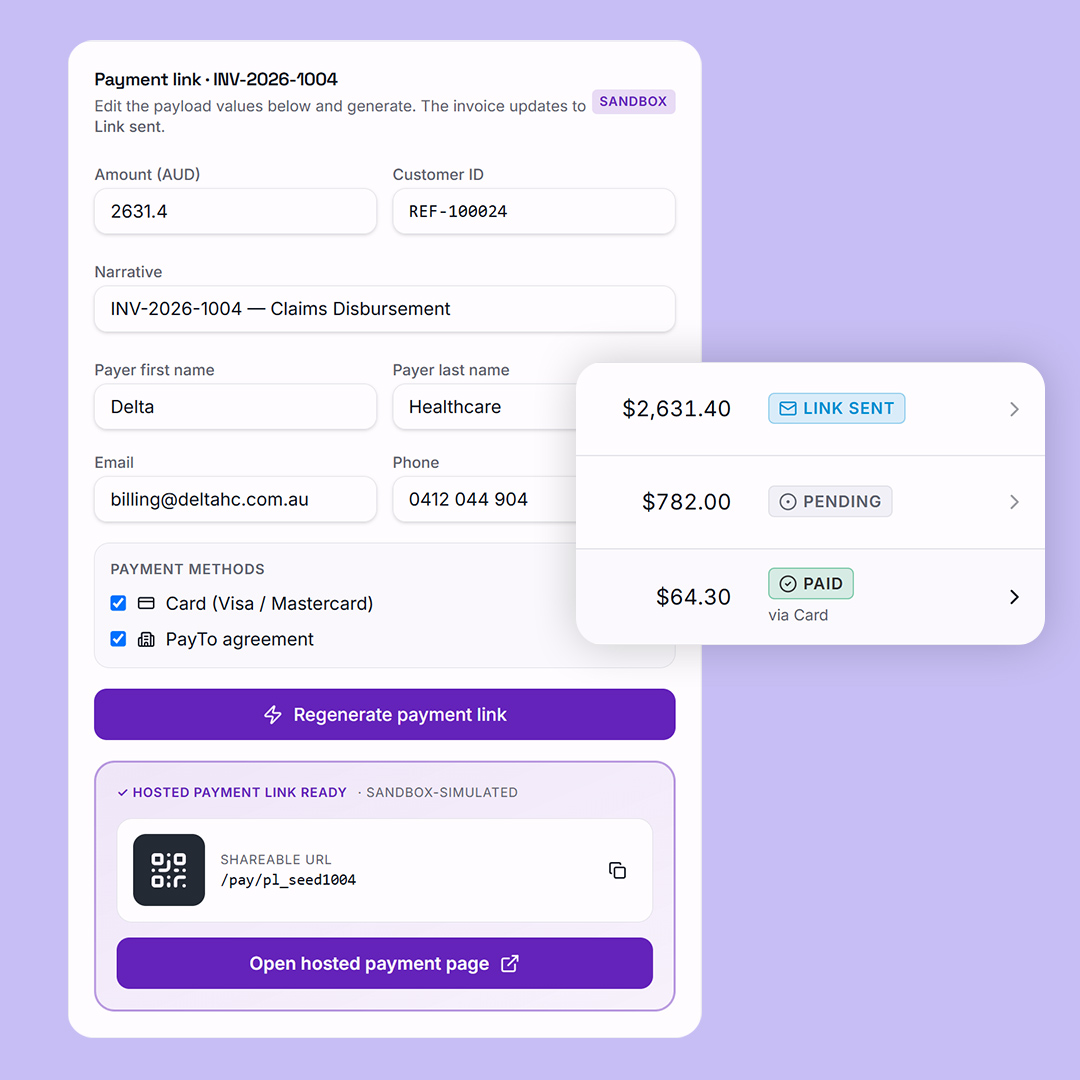
Instead of sending documentation and waiting for a customer to log into their bank and transfer funds, it’s now possible to send a single URL containing the payment information. The customer can click the link, select their preferred payment method and complete the transaction in seconds, without the need to log into a banking platform, navigate a website login or copy and paste account and reference numbers.
When paying is fast and frictionless, customers may be more likely to act on a request immediately rather than deferring it to later. For businesses that depend on steady cash flow, such change in customer behaviour could translate into a measurable reduction in outstanding receivables.
Payment links also support a broader range of payment methods than a standard invoice, which usually only has a credit card or direct debit option. Rather than defaulting customers to a bank transfer or a single card terminal, businesses can offer cards, digital wallets and real-time bank payment options including PayTo, within a single link.
Where payment links are most useful
The payment link model suits a range of collection scenarios.
One-off payments such as deposits, project invoices or ad hoc top-ups are straightforward candidates for ‘click to pay’. So is payment recovery: when a transaction fails or a scheduled payment is missed, a payment link can be generated and sent immediately rather than waiting for the next billing cycle.
For high-volume industries managing recurring obligations, links can be embedded into messaging flows so customers can resolve a failed payment after receiving a notification.
Customer-initiated payments, where a customer wants to settle an outstanding balance or make a payment outside a standard billing schedule, can also be made with payment links. There’s no need for them to phone the billing centre: businesses can generate a link on demand and send it directly.
See more: How payment links work with Monoova
Provide a modern payment solution
Slow payment experiences lead to slow and overdue payments, and customers who use modern banking systems and apps often expect their invoices to keep up.
You may have even noticed it yourself when bills arrive: an invoice notice lands in your inbox and you think, “I don’t have time right now” because you don’t want to open your banking app to take care of it.
From the business perspective, if your team is being slowed down by manual follow-up and failed payment management processes, real costs are involved. If payment infrastructure automates the process and it’s easier for customers to pay with a single link, there is the potential to save time and money.
Monoova's Payment Links solution is built on this logic. By powering payment links through real-time and account-to-account rails, including the NPP and PayTo, it gives businesses a way to unify payment collection, tracking and reconciliation within a single infrastructure layer.
For many organisations, integration effort can be reduced:: links can be generated via an API and embedded in existing billing engines, CRMs, or accounting tools without rebuilding workflows. Once payments are complete, notifications arrive in real time via webhook, so downstream processes can trigger automatically the moment a payment clears.
The result can be a collection model that is faster to deploy, easier to manage and more likely to support completed payments on the first request.
Want to know more about introducing payment links for more streamlined collections? Speak with a member of our team today.
FAQs
Q1: What are payment links?
A1: Payment links are secure URLs that allow customers to complete a payment instantly without manually entering bank details or navigating a banking platform.
Q2: How do payment links improve cash flow?
A2: Payment links reduce friction in the payment process, making it easier for customers to pay immediately and helping businesses reduce outstanding receivables.
Q3: Can payment links support multiple payment methods?
A3: Yes. Payment links can offer various payment options, including cards, digital wallets, PayTo, Direct Debit and real-time bank payments through a single payment experience.
Q4: How can payment links help with failed payments?
A4: When a scheduled payment fails, businesses can instantly generate and send a payment link, allowing customers to resolve the payment without waiting for the next billing cycle.

.png)