
Why Healthcare Payments Need Real-Time Infrastructure, Not Manual Billing Workflows
Healthcare organisations manage some of the most complex payment environments of any sector.
A single patient interaction can involve multiple payers, several payment methods and a chain of administrative steps that need to be reconciled accurately before revenue is confirmed. At scale, that complexity can hold up finance team efficiency and impact customer experience, and it shows, with JP Morgan’s 2025 Healthcare Payments Trends Report1 saying patient collections are the primary revenue concern for providers.
Providers have KPIs to protect margins as patient balances rise, yet the financial systems many hospitals and health clinics rely on have manual billing workflows and match-based processing that may not fully align with the modern payments environment. As patient volumes grow and expectations around speed and ease of payments shift, the gap between what outdated systems can handle and what finance teams actually need is becoming a more urgent problem.
The limits of manual billing at scale
When payment confirmation depends on end-of-day batch runs, finance teams may be working from yesterday's picture. Settlement delays can create cash flow uncertainty, and manual matching of payments to invoices introduces the kind of errors that are easy to miss and time-consuming to resolve.
For healthcare providers managing high transaction volumes across patients, insurers and third-party payers, small problems can quickly become large ones. Potential revenue leakage from unmatched payments, duplicate billing errors and delayed reconciliation can add up, as well as the administrative work required to catch and correct it.
Lack of visibility can also makes things difficult. When billing systems and banking rails operate independently, finance teams can lose sight of where money actually is, and this creates blind spots and confusion over the organisation’s true financial position.
Why billing tools alone don't fix the problem
Payment delays and reconciliation errors are often viewed as a billing software problem, but the issue often comes down to the underlying infrastructure.
This is because billing platforms manage invoicing and payment requests, but they don’t control how quickly money moves or how accurately it is matched when it arrives in the back-end system.
The settlement layer sits beneath the billing system, and if that layer is still running on batch cycles, upgrading the billing software may not fully resolve the problem of payments that settle overnight or reconciliation still happens in fixed windows. As a result, finance teams still spend time on time-consuming manual intervention.
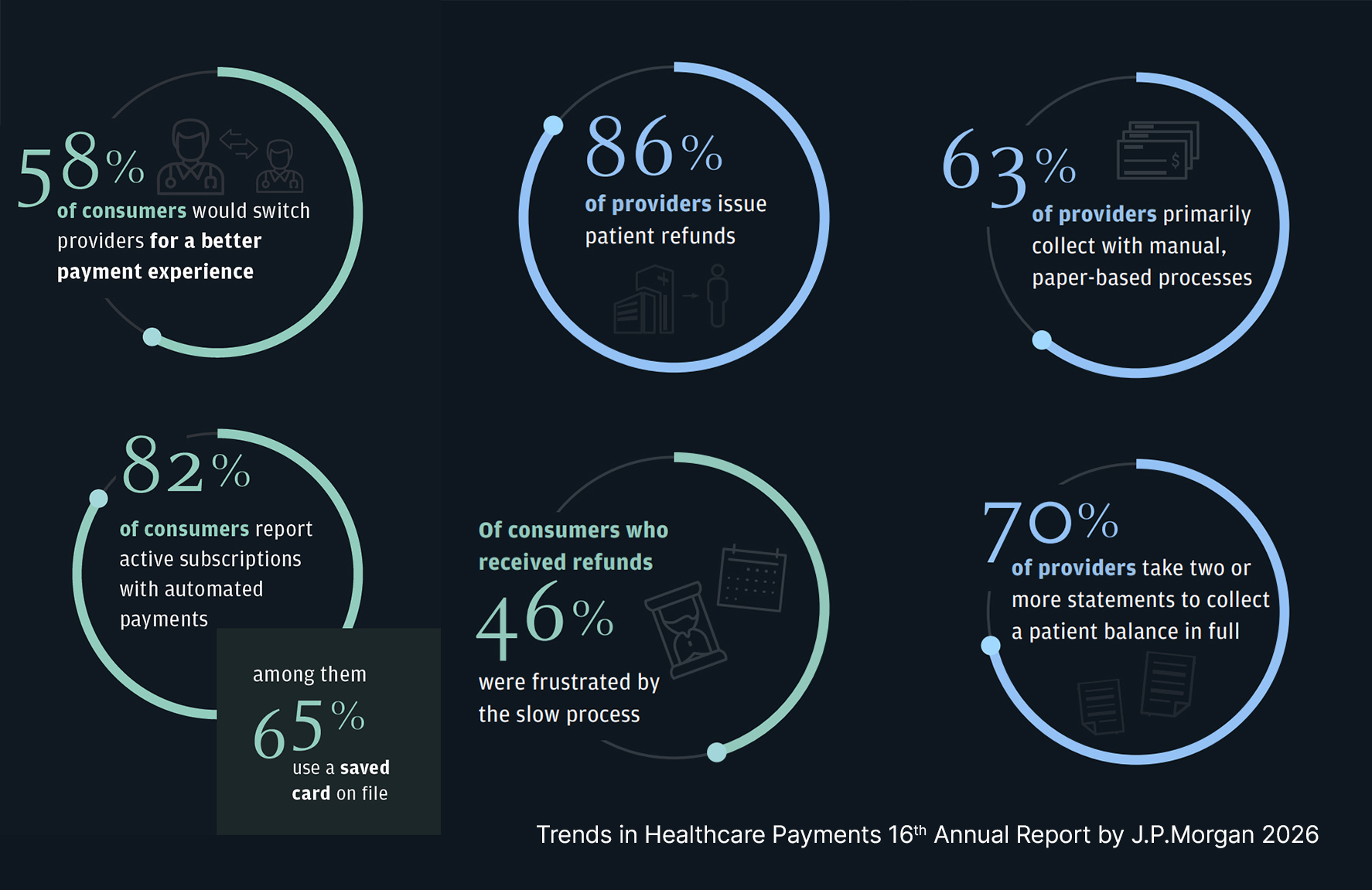
As 2026 research from JP Morgan2 also explains, modernising healthcare payments can reduce friction for consumers and staff while improving provider cash flow and administrative efficiency.
What real-time payment infrastructure can enable for the healthcare industry
Australia's New Payments Platform (NPP) enables data-rich payments to settle in near real-time, around the clock, seven days a week.
Incorporating this technology within a healthcare provider environment allows payment confirmation to happen in real time, rather than at the end of a processing window.
The additional data provided also opens the door to automated reconciliation, which saves finance teams time and reduces the issue of ‘orphaned’ payments by enabling automated matching, confirmation and recording as payments occur.
The good news is that a complex engineering project may not be required for healthcare providers to move from legacy to modern payment systems.
Monoova’s payment solution connects healthcare businesses to the NPP and the broader payments ecosystem, including PayTo, PayID, Direct Entry and card payments, through a single API integration.
Using Monoova’s API, rather than managing multiple payment channels separately, finance teams gain a unified view of incoming and outgoing funds, with automated reconciliation running continuously in the background.
The operational case for making the shift
Healthcare finance teams that spend hours each week on reconciliation, exception handling and payment follow-up are adding to the cost of doing business in what is an already stretched industry.
The technology already exists to reduce this administrative burden, power real-time fund settlement and improve cash flow visibility for healthcare providers. This is in the form of Monoova’s easy to use, plug-and-play API, which is designed to move money in a way which is fast, smart and transparent.
The solutions Monoova provides include:
- Real-time settlement via the NPP
- Patient-friendly payment options via PayID
- BPAY for patients who prefer to pay through their bank
- Direct entry for bulk disbursements
- Card payments for point-of-care transactions
- Virtual accounts for individual patients or billing entities
With Monoova, whether a payment comes from a patient, an insurer or a third-party payer, it generally moves through the same infrastructure and can be reconciled against the same data layer. Monoova’s client Wagepay explained, “We see clear benefits in moving our customers onto PayTo so they can enjoy better visibility and control over their money. For us as a business, reconciliations are easier too, so PayTo is a much better user experience for everyone”3
For providers handling payments from patients, insurers and third-party payers simultaneously, that consolidation can help to replace manual cross-referencing with a unified, accurate view of payment data. The can result in less time spent on payment administration, fewer back-end errors to resolve and a financial operation that scales with the organisation rather than against it.
Where significant investment of time and money was once required for healthcare organisations to streamline payments, Monoova provides a smart and fast solution, designed to integrate with existing tech stacks via API.
Discover how Monoova helps healthcare providers streamline patient payments, automate reconciliation and improve cash flow with real-time payment infrastructure. Speak with a Monoova specialist today.
FAQs
Q1: What is healthcare payment infrastructure?
A: Healthcare payment infrastructure is the technology that enables providers to receive, process, reconcile and track payments from patients, insurers and third-party payers.
Q2: Why are manual billing workflows a challenge for healthcare providers?
A: Manual billing workflows often rely on batch processing, delayed settlement and manual reconciliation, creating administrative burden and reducing cash flow visibility.
Q3: How can real-time payments improve healthcare operations?
A: Real-time payments provide faster settlement, improved payment visibility, automated reconciliation and a better experience for both patients and finance teams.
Q4: What role does the NPP play in healthcare payments?
A: Australia's New Payments Platform (NPP) enables near real-time payments with richer transaction data, helping healthcare providers automate payment processing and reconciliation.
Q5: Can healthcare organisations modernise payments without replacing existing systems?
A: Yes. API-based payment infrastructure can integrate with existing billing, practice management and finance systems without requiring a complete rebuild.
1https://www.jpmorgan.com/payments/newsroom/healthcare-payments-trends-report-2025
2https://www.instamed.com/trends-in-healthcare-payments-annual-report/
3Results depend on individual circumstances including transaction volumes, existing systems and implementation approach.

.png)
.png)