

For Australian businesses that rely on timely payments, the gap between requesting funds and actually receiving them can be a source of frustration.
Direct debits can take one to two days to clear, and a dishonour often arrives after the fact, leaving finance teams to chase failed payments.
PayTo was built to close that gap. Monoova’s latest update makes adoption even simpler, enabling businesses to create and manage PayTo Agreements through an easy-to-use, self-service client portal, with no API integration required.
Introducing PayTo on Portal
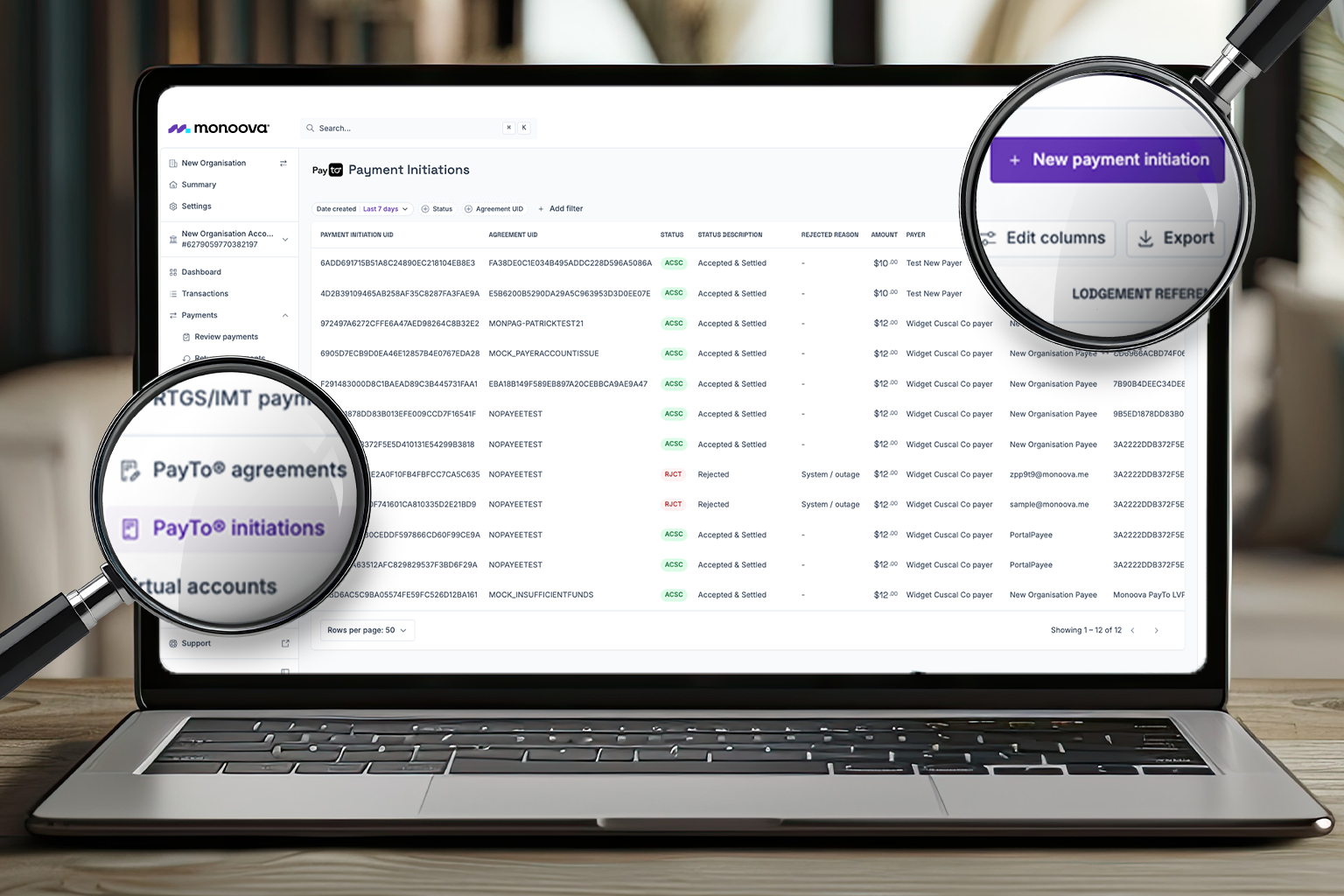
Monoova’s payment processing solution has included PayTo since the early days, and our latest update has brought PayTo into the Monoova Client Portal, giving businesses a single place to create PayTo agreements, initiate payment requests and track the status of both.
This feature will be live from 27 July, 2026.
With PayTo on Portal, businesses can:
- Easily create PayTo agreements and payment initiation requests
- Quickly see the status of agreements and payment initiations
- Control when payments are requested and received
- Use previously created agreements as templates to save time when creating similar agreements
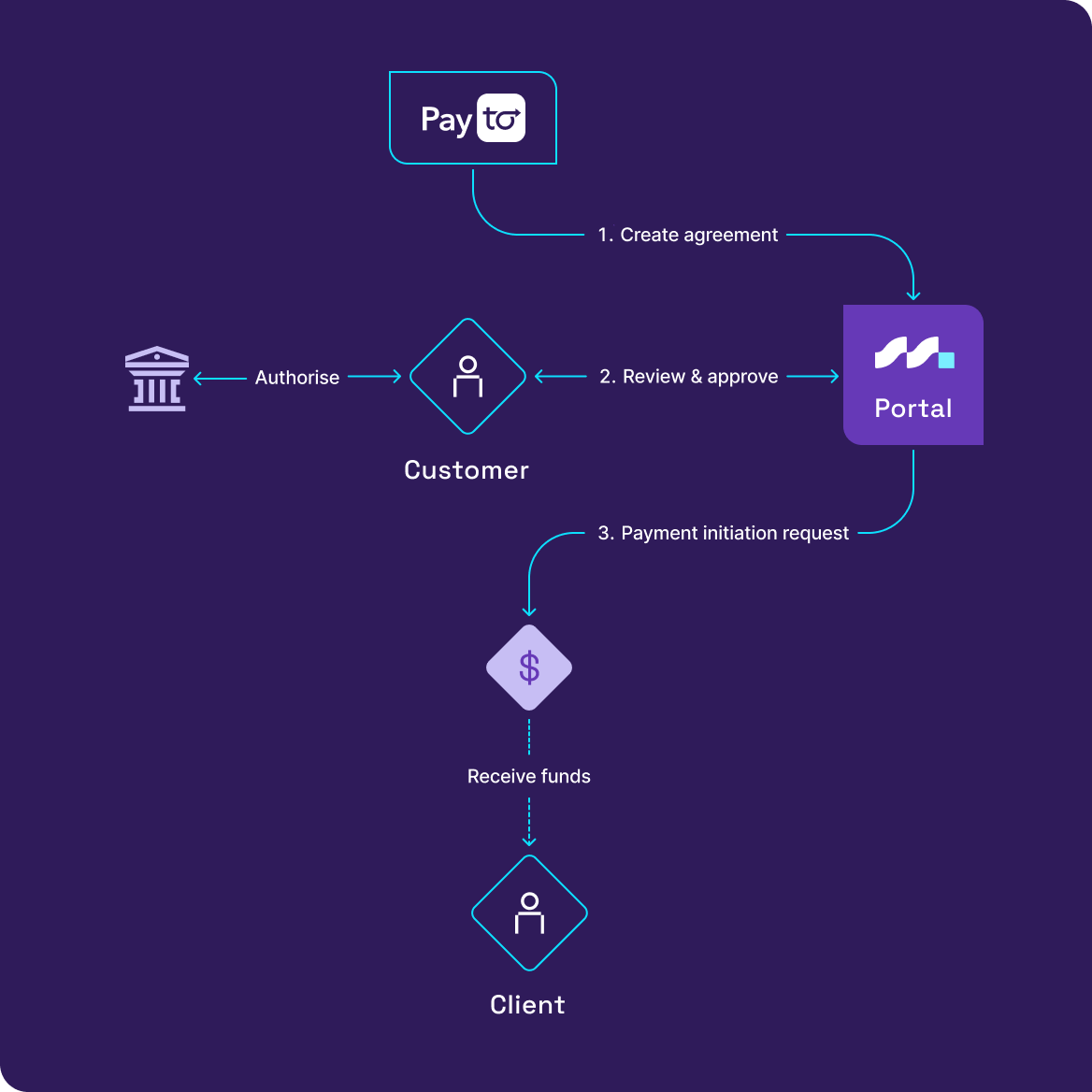
Monoova’s offering of PayTo on Portal gives access without the need for API integration. For businesses looking to receive real-time payments, this upgrade offers: setting up agreements, monitoring their status and initiating payments, all from a single interface, with the same real-time visibility and control that defines PayTo itself.
PayTo represents a meaningful shift in how Australian businesses can manage payments, helping to move away from the delays and uncertainty of batch-based direct debits towards a system built on real-time visibility and customer-controlled authorisation.
With PayTo now available on the Monoova Payments Portal, businesses have a more direct way to put these benefits into practice, from creating and managing agreements to tracking payment status, all from a single interface.
What is PayTo?
Introduced in 20221, PayTo is a real-time payment method that lets businesses request and receive funds directly from a customer's bank account on a scheduled or one-off basis, with the customer's authorisation managed within their own online banking.
Rather than relying on a card number or a manually set up direct debit mandate, a customer can approve a PayTo agreement using their PayID or their BSB and account number, in the same secure environment they already use to manage their banking.
Once an agreement is authorised, a business can send a one-off, adhoc, or recurring payment initiation request to debit the funds. Because the request runs over the NPP, real-time confirmation follows almost immediately, which can help to reduce the processing delays associated with traditional batch-based direct debits.
How PayTo works
A PayTo arrangement starts with an agreement: a business sends a request outlining the payment terms (the amount, where the funds will be debited from, purpose and frequency) to the customer. The customer reviews and authorises this directly in their banking app or website, so funds can only be debited once that authorisation has occurred.
From there, a business can submit a payment initiation request when funds are due. Critically, this request is designed to check fund availability ahead of processing, helping flag potential issues earlier than traditional batch processing. If a customer doesn't have sufficient funds, this is typically flagged within moments rather than days later, as can happen with traditional direct debits; i.e. if there is an insufficient fund, the payment initiation will show a rejected status with the rejected reason as insufficient funds, and the business can then take the appropriate action.
Customers can retain visibility and control throughout. Agreements can be viewed, paused, resumed or cancelled directly within online banking2, without needing to contact the business directly to make a change.
Why PayTo matters for business owners
The shift from a batch-based, potentially delayed process to real-time transactions can have practical benefits for cash flow and finance operations.
- Because processing occurs over the NPP rather than in scheduled batches, payments can clear more quickly and with clearer status visibility.
- Authorisation happens upfront and is visible at the point of payment, which can help reduce the number of failed payments that would otherwise only surface after the fact.
Reconciliation can also become more straightforward, as structured, real-time data may reduce the need for manual matching. PayTo via API solution carries structured, real-time data and immediate status updates, payments can be matched against records without the manual follow-up that batch-based reconciliation can require. And because mandate records sit in a centralised system with clear visibility over agreement status, there's less reliance on back-and-forth between providers, customers and financial institutions to resolve issues.

These benefits can extend to industries that depend on recurring or scheduled payments, including subscription and recurring billing, loan repayments and instalments, utilities and regular service payments, insurance premiums, educational facilities and memberships or SaaS billing. For many businesses in these industries, the combination of upfront authorisation, real-time fund checks and immediate confirmation can help to reduce the administrative load that typically comes with managing customer payments at scale.
The case for PayTo has also become more pressing with the Reserve Bank of Australia's ban on card surcharging, due to take effect from October 2026. Businesses that have relied on passing card processing costs onto customers will most likely need to absorb these costs directly once the ban applies, which makes a low-cost, real-time rail like PayTo a compelling alternative for recurring billing, instalments and other high-volume payment types where a card isn't strictly necessary.
FAQs
Q1: What is PayTo?
A1: PayTo is an Australian digital payment service that allows businesses to request payments directly from a customer's bank account through secure, customer-authorised agreements managed within online banking.
Q2: How does PayTo work for businesses?
A2: Businesses create a PayTo agreement that defines payment details including amount, frequency and purpose. Customers then authorise the agreement through their banking app or online banking before payments can be initiated.
Q3: How is PayTo different from Direct Debit?
A3: Unlike traditional Direct Debit, which relies on batch processing and delayed confirmation, PayTo operates through Australia's New Payments Platform (NPP), enabling real-time payment initiation, visibility and status updates.
Q4: What are the benefits of PayTo for businesses?
A4: PayTo helps businesses improve cash flow visibility, reduce failed payments, simplify reconciliation and provide customers with greater control over recurring and scheduled payment arrangements.
Q5: Can PayTo be used for recurring payments?
A5: Yes. PayTo supports recurring payments for subscriptions, memberships, loan repayments, utilities, insurance premiums and other scheduled billing arrangements.
Move beyond traditional payment delays with PayTo on Portal. Create agreements, initiate payments and monitor payment status through a single platform with real-time visibility and control. Discover how Monoova helps businesses simplify recurring payments with PayTo. Talk to an Expert.
1 https://www.auspayplus.com.au/payto-commences-rolling-out-for-first-payment-service-providers
2 https://www.nab.com.au/personal/online-banking/digital-payments/payto
.png)
.png)

