
From consumers to business owners, the threat of e-fraud and scams is constant for anybody who is active online.
The ACCC reported that Australians were affected by $2.18 billion in scam losses in 2025, up 7.8 per cent from 2024. While investment scams are the largest loss category at around $838 million, the average loss was around $400 per scam, which suggests scams are becoming higher volume rather than higher value, and shows how nobody is immune.
This article explains what e-fraud looks like and where it comes from, how the Government is taking steps to protect consumers and where the payments industry fits in when it comes to preventing this type of crime.
What is e-Fraud?
e-fraud describes any deliberate attempt to move money, value or access through deception, in a digital environment. It could be a ‘phishing’ message designed to trick someone into revealing a password, a fake online store that takes payments but never sends goods, or a demand for payment disguised as a message from a bank or tax-related authority.
Fraudulent activity uses bots to test stolen card details in bulk, creates waves of fake accounts, and continually probes digital checkout and login flows for weaknesses and entry points. It’s not all performed by hackers either. A common form of e-fraud that affects businesses happens when a legitimate customer disputes a valid transaction, and it results in a chargeback to the vendor.
The Australian Signals Directorate receives a cybercrime report every six minutes.
With billions of dollars lost, the impact can extend beyond financial losses to higher costs, more legitimate transactions being incorrectly declined and declining customer trust. A major ransom incident can cost tens of thousands of dollars, while smaller transaction-related losses can quickly add up. Unfortunately, 65% of victims never get their money back.
Understanding Australia’s Scams Prevention Framework
Many businesses are already obligated to report a cybercrime, incident or vulnerability. To add to this, the Australian Government's newly introduced Scams Prevention Framework (SPF) is designed to help protect consumers from scams.
Under the SPF Act, banks, telecommunications providers and digital platforms (the sectors where the greatest harm to consumers is reportedly coming from), will have obligations to prevent, detect, disrupt, respond to and report scam activity, with civil penalties reaching up to $50 million in the event of non-compliance.
Businesses will be expected to take reasonable steps to:
- Stop scams from reaching consumers in the first place, with telcos expected to block scam texts, digital platforms to remove fake ads and banks to warn customers about emerging scam tactics.
- Identify scams as they happen or after the fact, for example by using algorithms to flag suspicious activity on their platforms.
- Interrupt suspected scam activity and limit consumer losses by suspending scam accounts and contacting affected users, or adding friction points to slow down high-risk payments and ensure large amounts of money are not transferred to unauthorised people.
The Australian Financial Complaints Authority (AFCA) has been authorised to oversee dispute resolution in this area, giving consumers and small businesses a single place to raise scam-related complaints. Organisations that provide or operate a Regulated Service within a Designated Sector (including banks, telecommunications providers and digital platforms) are legally required to become members of the AFCA if they are not already.
How the payments ecosystem recognises and combats e-fraud
In Australia and around the world, e-fraud prevention relies on a multi-layered, real-time approach, and there are many strategies being employed.
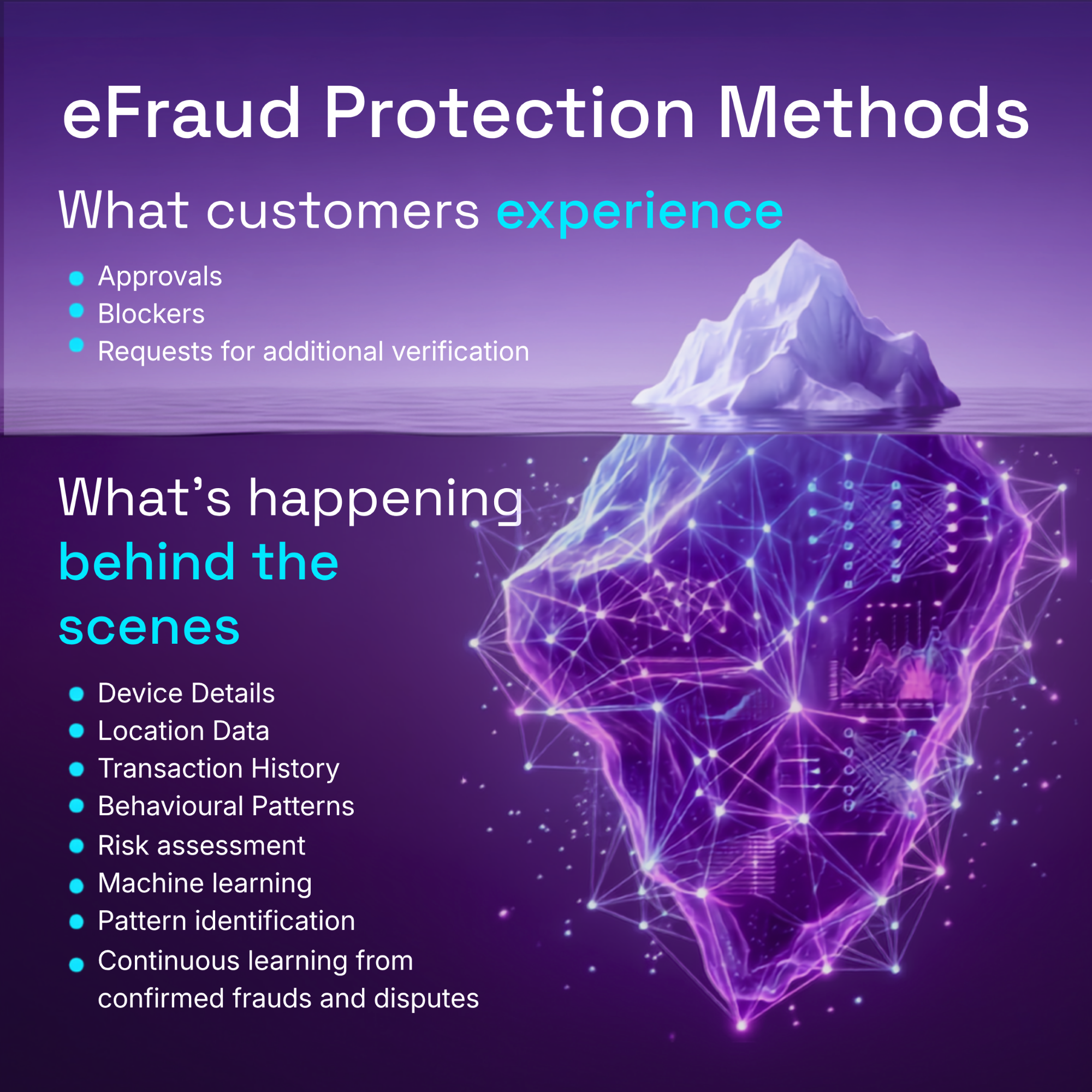
For example, many digital payment systems can now collect contextual signals (device details, location data, transaction history and behavioural patterns) and assess risk before approving, blocking or requesting additional verification accordingly. Machine learning can strengthen this by identifying patterns too complex for static rules, learning from confirmed fraud and disputes to help improve future decisions as fraudulent tactics evolve.
Rather than applying the same level of friction to every transaction, the payments industry is moving toward risk-based controls that escalate depending on the level of risk. Low-risk payments should still proceed with minimal interruption, while higher-risk transactions may now trigger additional verification, contextual warnings or a short delay for review in order to help reduce the risk of funds being lost due to a scam.
The tools being used to help prevent e-fraud can also be simple, for example, Confirmation of Payee (CoP) checks a payee's account name, BSB and account number against the receiving institution's records before a payment is finalised, issuing a warning if information doesn’t match. This has become an industry-wide fixture, with the service reportedly operating across 83 financial institutions and more than 143 million accounts as of March 2026.
How Monoova is joining the fight against e-fraud
Monoova’s payments solution operates within a layered control environment: Monoova has its own controls, our clients have controls, and our banking partners have controls, each contributing different visibility across the payment journey.
When it comes to e-fraud, we believe prevention should start before a payment is ever initiated. Strong onboarding processes, client due diligence and risk appetite decisions are treated as some of the most effective upstream controls available, and Monoova’s risk management team will not approve businesses that fail to meet these standards. This is intended as a first step in reducing the risk of onboarding unreputable providers onto on Monoova’s platform.
To add to this, we take security seriously. Our platform is PCI-DSS and SOC 2 compliant and includes multi-factor authentication as standard and end-to-end encryption with your own private tokens/keys, all designed to help protect businesses and their customers.
Monoova isn't directly included in the Scams Prevention Framework, but we are working towards aligning relevant practices with its expectations, on the basis that a safer payments ecosystem is worth pursuing on its own merits, not only where regulation requires it.
We take e-fraud seriously, and are advocates of real-time, reciprocal intelligence sharing, as a way to build a richer picture, and are in regular communication with the digital platforms, telcos and payments providers that are on the frontlines of unusual activity. When issues are identified and shared, they create a clearer picture that everyone can learn from.
Protecting consumers from e-fraud is an industry-wide endeavour
e-Fraud is constantly evolving, with fraudsters continually coming up with new tactics to separate people from their money. Unfortunately, it isn't a problem that will be solved by any single piece of legislation, tool or organisation.
The Scams Prevention Framework marks a shift in how Australia holds banks, telcos and digital platforms accountable for some of the most common causes of scam-related loss, but its success will depend on how effectively those sectors are able to identify and take steps to prevent new scams as they arise.
For businesses handling payments, prevention needs tostart early and controls need to be connected rather than siloed. Meanwhile,friction needs to be applied where risk is highest rather than everywhere at once, in order to protect the seamless paymentflows Australians are becoming increasingly used to.
From our perspective, protection should be built into the product, the partnerships and the people behind payments, as far as possible, wherever money moves. That's something no single business can achieve alone, and we will continue to collaborate with our peers and clients to reduce the risk and impact of e-fraud in Australia and beyond.



.png)